Instant games have become a large part of mobile casino play because they are quick, simple and work well on a phone. There are no reels or complex rules: you set your bet and your risk, and the result arrives straight away. Many come with provably fair checks and crypto betting. Below we sort the main types of instant casino games into families and explain how each one plays, from Plinko and Limbo to Dice, HiLo and Mines.
The families below group games by what the player decides. Some games let the player set the risk before the result. Others let the player stop a result that is already running. Some games leave the odds fixed for every round. The sections that follow explain each family in that order.
Each section names the game, explains how one round works and points to a guide for the next step. The table after the families gives a side-by-side view for quick comparison.
Multiplier games
Limbo
In Limbo you set a target multiplier before you bet. The game then draws a random multiplier. If it equals or beats your target, you win your stake times the target. A low target wins often and pays little; a target of 100x or 1,000x pays far more and rarely hits. Limbo is usually provably fair and widely available at crypto-friendly mobile casinos.
It suits players who want to set their own risk and make quick decisions. Read how to play Limbo for a full walkthrough.
Limbo locks the target before the draw. The game then samples one multiplier and compares it with that target. A target close to 1x hits on most draws and multiplies the stake by a small number. A target of 100x or 1,000x hits rarely and multiplies the stake by that target when it hits. Earlier rounds do not change the next draw. The player cannot cash out during the round, because the result is already fixed when the multiplier appears.
Limbo and Dice share one idea: the target is locked before the result. The target sets the win chance, and the payout follows from that chance. A player who wants a steady pattern should compare several targets before choosing one large multiplier.
Number and card games
Dice
Dice is one of the oldest instant games and a staple at crypto casinos. You pick a number between 1 and 100 and bet on whether the roll lands over or under it. The less likely your call (for example, over 95), the bigger the payout.
Dice shows its win chance openly and lets you fine-tune your risk every round. See how to play Dice and our Dice strategies for beginners. Dice-themed games on our site include Dice King, Double Dice, Dice Dice Baby, Dice Bonanza, Lucky Dice.
HiLo
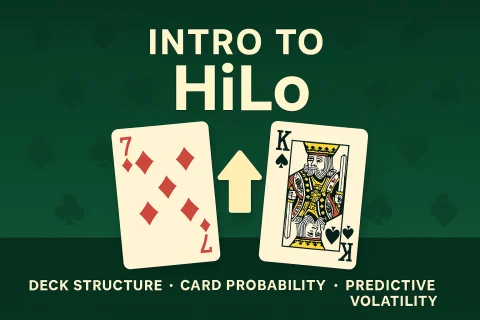
HiLo is a card game where you guess whether the next card is higher or lower than the one showing. It is quick to learn and usually has a clean two-button layout on mobile. Most versions let you chain guesses for a rising multiplier and cash out at any point, so it works for both cautious and aggressive play.
It suits players who like a little card logic in a fast game. Read how HiLo works for the odds behind each guess.
Dice uses a number line from 1 to 100. The player picks a cutoff and a side, over or under. A roll on the chosen side pays the stake times the displayed multiplier. A tight band, such as over 95, pays more because fewer numbers win. A wide band, such as under 50, pays less because more numbers win. The win chance sits next to the slider before the bet is placed. The roll itself is one number. Bet-size plans change how much is staked. They do not change the chance of that single roll.
HiLo shows one card and asks whether the next card is higher or lower. A middle rank, such as 7 or 8, leaves a similar count of cards on each side. An ace or a king leaves most of the remaining cards on one side, so that call pays less and the opposite call pays more. A chain of correct calls raises the multiplier. A cashout ends the chain and pays the multiplier reached so far. A wrong call ends the chain and loses the stake. Two buttons cover the whole choice, which is why the game fits a phone in portrait.
In HiLo, each correct guess adds to the multiplier, and a wrong guess ends the chain. The decision to stop is the main risk control in the game. Stopping early keeps a smaller win, while going on raises both the reward and the chance of losing the stake.
In Dice, the number line is always on screen, so the win chance is visible before each roll. Change the cutoff and the payout changes with it. Compare the win chance and the payout before you bet, not after the roll.
Binary outcome games
CoinFlip
CoinFlip is as simple as it gets: you bet on heads or tails, and the result is immediate. The odds are fixed at close to 50/50, with a small house edge on the payout. It needs almost no thought, which makes it popular with beginners and with players who want small, fast bets on their phone. Some versions add animations or themes.
It suits short sessions and players who like a plain yes or no. See how to play CoinFlip. Examples include Coin Flip, Coin Field.
CoinFlip offers two outcomes and no slider. Heads and tails each sit near an even split, and the payout is a fixed multiple of the stake after the house edge. The player cannot raise the payout by picking a rarer side, because both sides are the same bet. Themes and coin animations change the picture. They do not change the two-way result. A short session fits the game because each round is one tap and one result.
A CoinFlip bet has one decision, so the stake is the main variable. Small stakes spread the same house edge over more rounds. Large stakes reach a loss faster. Choose the stake before the first flip and keep to it for the whole session.
Grid games
Plinko
In Plinko you drop a ball through a board of pegs. It bounces at random and lands in one of the slots at the bottom, each with its own multiplier. You can usually change the number of rows and the risk level, which changes how spread out the payouts are.
With its random bounces, arcade look and adjustable risk, Plinko is one of the most watchable instant games. See how to play Plinko and how to choose rows and multipliers. Plinko games on our site include Plinko X, Plinko XY, Plinko Dare 2 Win, Plinko Rush, Plinko Go.
Mines
Mines is based on Minesweeper. You choose how many mines hide in a grid, then tap to reveal tiles. Each safe tile raises the payout, and hitting a mine ends the round. The more mines on the board, the higher the multipliers and the shorter most rounds last.
It suits players who like making a decision on every tap. The result is luck; your cashout timing decides how much of it you keep. See how to play Mines. Examples include Mines Dare to Win, Turbo Mines, Minesweeper XY, Gold Digger Mines.
Plinko starts when the player drops a ball onto a peg board. Each peg sends the ball left or right, and the ball lands in one bottom slot. Each slot carries its own multiplier. More rows add more pegs and a wider set of slots. A low-risk board places most slots on small multipliers. A high-risk board places large multipliers on the outer slots and small multipliers in the middle. The player sets rows and risk before the drop. One ball's path does not forecast the next drop.
Mines hides a chosen number of mines on a grid of tiles. A safe tile raises the current multiplier. A mine ends the round and loses the stake. More mines leave fewer safe tiles, so each safe tap steps the multiplier up by more. Fewer mines leave a longer path of smaller steps. The player can cash out after any safe tile and keep the multiplier reached so far. The next tile is still chance. The cashout is the remaining decision once the mine count is set.
In Plinko, the row count and risk level are set before the ball drops. More rows spread the slots across a wider range of payouts. A low-risk setting keeps payouts closer together, while a high-risk setting pays a few large results and many small ones.
In Mines, the mine count is set before the grid opens. A higher count means fewer safe tiles and a faster rise in the payout. Each tap is a separate decision, so the cashout point matters as much as the first tile.
Instant games compared
| Game | Gameplay type | Risk control | Visual appeal | Best for |
|---|---|---|---|---|
| Limbo | Multiplier betting | Yes: set the multiplier | Basic | Risk-takers |
| Dice | Number prediction | Yes: set the win chance | Basic | Players who like to plan |
| CoinFlip | Binary outcome | No: fixed odds | Basic | Beginners and fast play |
| HiLo | Card prediction | Yes: higher or lower, and when to stop | Medium | Card game fans |
| Plinko | Ball drop through pegs | Yes: rows and risk level | High | Players who like visuals |
| Mines | Grid reveal | Yes: number of mines | High | Interactive play |
The table shows the decision each game asks of the player. Risk control means the player can change the odds or payout before a round. Visual appeal describes how much animation and theme a game carries. Neither column measures the return to player, because the return depends on the provider and the rules of each game.
A player who wants control should look at the risk control column first. A player who wants speed should look at the gameplay type column, because that column shows how many decisions each round needs.
Other types of instant games
Limbo, Dice and Mines are the best-known titles, but many casinos now add newer and hybrid formats.
Crash games
Crash games are live multiplier games. A line, rocket, plane or character climbs with a rising payout until it suddenly crashes, and you must cash out before that to win. Well-known examples include Aviator, Spaceman and Bustabit, along with JetX, Fly X, Cash or Crash Live. They are especially popular at crypto casinos for their shared, multiplayer rounds and high volatility. Start with how to play crash games.
Boxes, cases and loot games
Based on video game loot boxes, these games let you open a case for a random reward, from a small win to a large multiplier. They are simple and often heavily themed, and they tend to appeal to adult players familiar with video game loot boxes who mostly play on mobile.
A crash round is shared. One multiplier climbs in public until it stops, and every player in that round sees the same stop point. A cashout before the stop pays the stake times the multiplier at the moment of the tap. A late cashout loses the stake. The cashout happens during the climb. That timing is the difference from Limbo, where the target is locked before the draw. Shared rounds are why crash titles sit in a lobby rather than on a private slider.
A loot case lists the rewards inside it before the player opens it. Each reward is a multiplier or a named prize, and the open draws one of those rewards. The player does not set a target multiplier or a mine count. The theme is the main difference between cases. The draw is one result per open. A run of small rewards does not raise the chance of the large reward on the next open.
Loot cases differ from the other families because the odds of each reward are set by the game before you open a case. Choosing one case does not change those odds. The decision is about the stake and the budget only.
Why players choose instant games
- Quick results: you tap, bet and see the result straight away.
- Control over risk: you can adjust multipliers, rows, mine counts or win chance to suit how you play.
- Low stakes: many instant games accept very small bets, which suits short sessions.
- Made for mobile: simple layouts and large buttons work well on touch screens.
- Provably fair options: at crypto casinos especially, you can often verify every round yourself.
Fast rounds also mean many bets in a short time, so set a budget before you start. Our responsible gaming page lists the tools to use. For a shortlist, see the best instant games for mobile players.
The risk control is not the same tool in every family. Limbo and Dice set the chance before the result. HiLo, Mines and crash games let the player stop a chain that is already running. CoinFlip and loot cases leave the chance fixed. A phone session that mixes these families spends a budget at different speeds. A crash round can finish in a second. A Mines grid can take many taps before a cashout.
Instant games suit a short session with a clear limit. Learn one family first, such as Limbo or CoinFlip, and read its rules before you bet. Mixing several families in one session makes the risk harder to track.
Instant games also suit players who want to compare outcomes across sessions. A written record of stake, game and result makes patterns easier to see. The record does not change a result, but it shows whether the chosen limit held.
Before the first bet, check the stake, the win chance or multiplier, and the cashout rule shown on the game screen. These three settings decide how a round ends, so they are worth reading before the game starts.