Key Takeaways
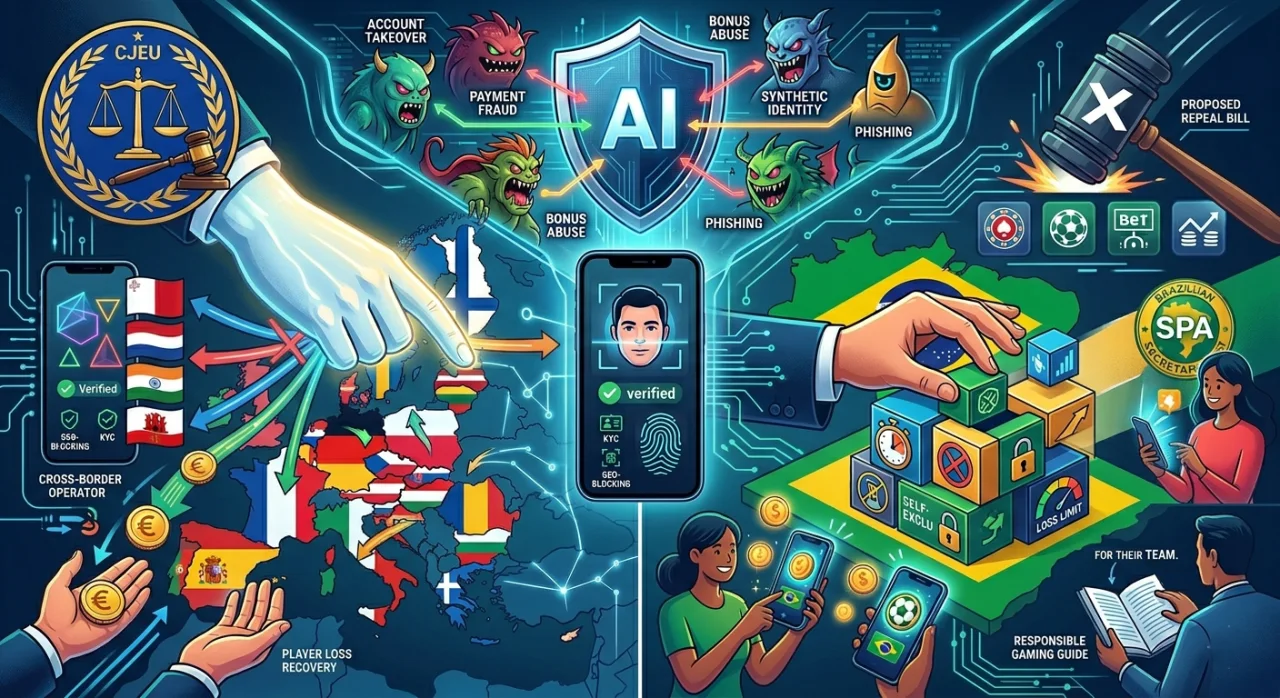
- CJEU decision upholds member states’ right to ban or restrict online casino and betting services, even from EU-licensed operators in other jurisdictions, while enabling player loss recovery claims.
- Brazil sees heightened regulatory scrutiny with new responsible gaming mandates and a proposed bill to repeal online gambling legalization.
- Mobile operators face ongoing pressures around cross-border access, player protection tools, and fraud prevention amid global enforcement trends.
EU Court Backs National Bans on Cross-Border Online Gambling
The Court of Justice of the European Union (CJEU) ruled on 16 April 2026 in Case C-440/23 that EU law does not prevent member states from prohibiting certain online gambling services — including casino games like virtual slots and specific betting forms — even when offered by operators licensed in another EU country. The judgment arose from a dispute involving Malta-licensed operators providing services to German players during a period when such activity was largely restricted in Germany.
The court affirmed national regulatory autonomy in the absence of EU-wide harmonization, emphasizing public-interest protections, such as preventing gambling addiction and fraud. It also clarified that players can pursue civil claims to recover losses from services deemed illegal in their home jurisdiction at the time of play. This dual outcome strengthens local licensing regimes while potentially exposing cross-border operators to refund liabilities and restricted market access. For mobile-first platforms, which dominate iGaming traffic, the ruling underscores the need for robust geo-blocking, localized compliance, and adaptive product strategies to navigate the fragmented European regulatory landscape.
Industry observers note this could limit the reach of Malta- or Gibraltar-based operators targeting stricter markets and encourage operators to prioritize jurisdiction-specific mobile apps or web experiences that align with national policies.
Brazil Advances Responsible Gaming Rules Amid Political Uncertainty
Brazil’s Secretariat of Prizes and Betting (SPA) continues to refine its regulatory framework for the rapidly growing online betting market, with a recent emphasis on mandatory player protection measures. New guidelines under Ordinance SPA/MF No. 1,231/2024 include deposit, time, and loss limits, self-exclusion options, behavioral monitoring, and educational campaigns to curb problem gambling. These build on earlier licensing requirements and biometric registration mandates for operators.
However, political headwinds persist. On or around 15 April 2026, a bill (PL-1808/2026) introduced by a Workers’ Party deputy proposed repealing the 2023 Bets Law that legalized regulated online gambling from January 2025, seeking a full nationwide ban on fixed-odds betting and online casino-style games. While the proposal faces significant hurdles, it reflects ongoing debates over social impacts in Latin America’s largest iGaming market. Mobile platforms, which rely on seamless UX and instant payments and are popular in the region, must now integrate enhanced responsible gaming tools to maintain compliance and player trust.
Additional initiatives, such as training programs for public servants on responsible gaming in states like Paraíba, highlight a broader push for education and prevention alongside enforcement against illegal operators.
Heightened Focus on Mobile Security and Fraud Prevention
Global iGaming operators are ramping up investments in AI-driven fraud detection and cybersecurity as mobile usage accounts for the majority of sessions. Threats, including account takeovers, payment fraud, bonus abuse, and AI-powered synthetic identity schemes, remain prominent, with reports indicating casinos continue as prime targets for cybercriminals. Real-time behavioral monitoring and biometric enhancements are becoming standard in mobile apps to strengthen KYC and session security.
While no major new app store policy shifts for gambling apps surfaced in the past week, ongoing compliance with platform rules (including proof of licensing and geo-restrictions) remains critical for mobile distribution. Payment innovations, such as faster instant options and open banking integrations, continue supporting frictionless mobile experiences but require layered security to mitigate fraud risks during deposits and withdrawals.
These developments illustrate a maturing global mobile casino landscape in which regulatory fragmentation, player-protection imperatives, and technological defenses shape operators' strategies. Cross-border models face greater hurdles, pushing platforms toward localized, secure, and responsible mobile-first designs. Markets like Europe and Latin America demonstrate how policy signals directly influence UX priorities, payment flows, and security investments.
Sources: CJEU judgments and related coverage (16–18 April 2026); Brazilian regulatory announcements and legislative updates (mid-April 2026); industry analyses on iGaming security trends.
Top 3 mobile casinos
- 1,500 USD + 150 FS
- 1,600 USD + 150 FS
- 5,250 EUR + 650 FS
18+ · T&Cs Apply · Play Responsibly